Build drawings
Eight drawing-led files carried the BOM, connector tables, cavity logic, wire callouts, branch dimensions, acceptance clauses and packing rules.
The main engineering source for the review. Circuitova
Engineering case · Supplier qualification
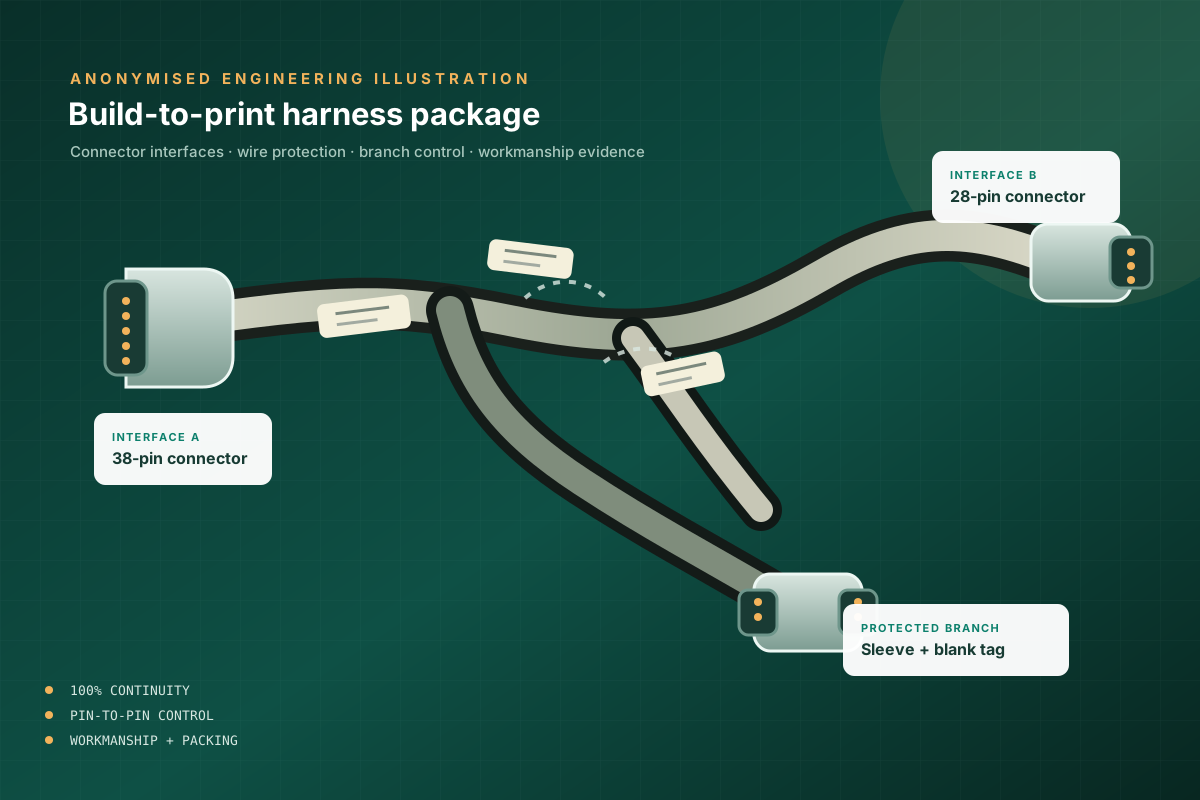
A multi-family vehicle harness package looked simple from the outside: connectors, wire and tape. The real requirement was to make eight engineering drawings, multiple connector systems and one build-to-print supplier work to a single approved standard.
Decision in one paragraph
The files described different harness families, connector interfaces, wire colours, branch lengths, protection methods and packaging rules. Several drawings repeated the same acceptance clauses, while others added branch-specific routing constraints. A supplier could quote every file and still miss the system-level controls connecting them.
We treated the drawings as one qualification programme: index the documents, decode the interfaces, translate repeated acceptance clauses into build controls, expose missing decisions, check supplier scope and define the sample and release evidence.
An IATF-certified supplier is not automatically the right supplier. Certification proves that a management system was assessed; it does not prove product-design ability, the best price or the best delivery response.
Scope at a glance
The figures below are examples found in the supplied files. They illustrate the control burden of this programme and are not a generic specification for a new harness. Customer, supplier, vehicle, drawing and part identifiers are withheld.
| Product family | CAN and head-unit harnesses, a 3 m tailgate-lock control harness, lamp-holder wiring and a fused rocker-switch power harness. |
|---|---|
| Interfaces | 38-position and 28-position connector systems, plug-and-receptacle variants, 4-pin tailgate connectors and several smaller power, lamp and switch connectors. |
| Wire examples | AVSS 0.3 mm² for signal circuits; 0.5, 0.85, 1.0 and 2.0 mm² conductors in bypass, lamp, switch and power circuits. |
| Length envelope | Short 90–180 mm branches through to 3,000 mm tailgate runs, with drawing tolerances and branch points. |
| Protection | Heat-shrink at connector exits, PVC tube, corrugated sleeve, fleece tape and waterproof splice coverage. |
| Electrical content | Relay and fuse circuits in the switch harness, twisted CAN pairs, plus pin-specific colours and point-to-point wiring rules. |
| Workmanship | 100% continuity, visual mismatch inspection, electrical performance checks and IPC620-class drawing requirements. |
| Compliance | RoHS and REACH required by the drawings; supplier management-system scope checked separately. |
| Packaging | 20 pieces per bundle where specified, uniform carton quantities and gross weight kept below 20 kg. |
Evidence inventory
The source package mixed controlled engineering documents with supporting media. Those categories do not carry equal evidential weight, so they were indexed separately before any supplier judgement was made.
Eight drawing-led files carried the BOM, connector tables, cavity logic, wire callouts, branch dimensions, acceptance clauses and packing rules.
The main engineering source for the review.IATF 16949, ISO 9001 and ISO 14001 certificates showed the assessed organisation, product scope and validity window.
Capability evidence, not first-article evidence.Product and process images supplied visual context for connectors, assemblies, workmanship, tooling and handling.
Reference media; not a substitute for batch records.Five short videos illustrated selected production or handling steps and helped frame questions for the supplier review.
No claim of a live factory audit or production release.Engineering anatomy
A single wrong terminal, branch length or wire colour can make a complete assembly unusable. The control point is therefore not only the cable supplier. It is the interface definition.
Connector views, cavity numbers, colours and branch destinations must remain aligned from drawing to fixture to finished harness.
The supplier was assessed for manufacturing scope. The engineering documents owned the design; this was not a product-design assignment.
Continuity alone is insufficient. The approval gate also needs visual workmanship, taping, terminal seating and packaging evidence.
Similar connectors and vehicle variants create a high risk of mixing left/right, colour, pinout or branch length after the first article.
Requirement extraction
Repeated clauses were consolidated without weakening any drawing-specific rule. The third column states what the build package should require; it is not a claim that every record had already been produced.
| Drawing requirement | What the supplier must control | Release evidence to require |
|---|---|---|
| 100% electrical continuity, mismatch inspection and functional check | Pin-to-pin continuity for every assembly, not a sample-only electrical test. | Fixture or test record linked to the drawing revision, plus visual mismatch check. |
| 20 pieces per bundle | Count control at final packing where this instruction applies. | Bundle count and a release photo or packing record. |
| Heat-shrink where connector and wire separate | Approved material, insertion depth, shrink quality and no exposed conductor strands. | Workmanship inspection and approved first-article photo. |
| IPC620-class workmanship | Terminal crimp, seating, conductor damage, insulation damage and assembly workmanship. | Visual acceptance criteria and trained-inspector sign-off. No certification claim is inferred. |
| RoHS and REACH compliance | Material declarations for the approved wire, insulation, sleeves, tape, terminals and housings. | Current declarations tied to the actual material and supplier, not a generic logo. |
| No oil, dirt, scratches or damaged insulation | Clean handling, cable protection and defined visual-defect limits. | Final visual inspection record and rejected-sample boundary. |
| Uniform carton quantity and gross weight below 20 kg | Carton count, labels, protection, gross-weight check and prevention of mixed variants. | Packing specification, carton count and weight record before handover. |
The drawings contain detailed process conventions. A quotation that ignores them can look comparable while describing a different finished assembly.
| Drawing convention | Control translation | Why it matters |
|---|---|---|
| Point-tape cover ends; re-tape long cover runs every 30 cm unless a branch has its own rule | Define tape type, overlap, direction and inspection points on the build sheet. | Prevents loose ends, unraveling and inconsistent branch protection. |
| Cover every splice with waterproof adhesive | Approved splice method and material, with no exposed conductor or weak strain relief. | Electrical continuity alone does not prove environmental protection. |
| Heat-shrink ground terminals located outside the cabin | Treat this as an installation-location-dependent rule, not a generic terminal finish. | The same connector can require different protection according to its route. |
| Bundle runs containing more than six wires use the specified B-type tape method | Control bundle diameter, tape type and branch-specific exceptions. | A single taping instruction cannot be applied uniformly to every branch. |
| Wire insulation temperature classes T1 / T2 / T3 map to defined conductor families | Keep the approved conductor family in the BOM and verify incoming material. | Similar-looking wire may not meet the same heat-resistance class. |
| Selected CAN pairs are twisted at one turn per 20–100 mm | Define pair identity, lay length, handling and inspection on the drawing-specific work instruction. | Correct continuity does not guarantee the required pair construction. |
| Wire examples range from AVSS 0.3 mm² to 2.0 mm²; branch examples range from 90 mm to 3,000 mm | Verify each BOM line, colour, gauge, length and tolerance against its own drawing. | Do not generalise these examples to a different harness or vehicle variant. |
Supplier qualification
What it did not prove
A certificate does not answer whether the quote is competitive, whether the lead time fits, whether the supplier responds quickly to engineering questions or whether the first article will meet the drawing.
This review is a documented capability assessment. It is not a claim that a physical factory audit, production release or shipment took place.
The working model
Categorise drawings, certificates, product photos and process videos before comparing suppliers.
Extract connector families, cavity maps, wire colours, gauges, lengths, sleeves and packaging rules.
List any part numbers, tolerances or acceptance criteria that cannot be inferred safely from the drawing.
Compare management-system scope, process fit, commercial response and build-to-print capability.
Approve pinout, terminal, wire, colour, branch length, taping, sleeving and label placement together.
Define 100% continuity and electrical checks, visual criteria, first-article approval and packaging evidence.
Do not treat a quotation or certificate as production approval. Release follows an approved sample and signed specification.
Control plan
| Risk | Required control | Evidence before release |
|---|---|---|
| Pinout or cavity mismatch | Approved pin-to-pin matrix and mating-connector check | Signed drawing and continuity fixture result |
| Housing or terminal substitution | Engineering approval for every connector and terminal | Approved BOM with no unreviewed alternatives |
| Wrong wire gauge or colour | Incoming material and first-article verification | Photo record and electrical test |
| Branch length or taping error | Dimensional first article and batch visual checks | Measured sample and approved golden photo |
| Damaged or poorly seated terminals | Workmanship inspection aligned with the drawing acceptance standard | Visual inspection and terminal-seating record |
| Packaging damage or overweight cartons | Bundle count, carton limit and final packing check | Packing record and carton weight |
Release review
A detailed drawing pack reduces ambiguity, but it does not replace the decisions made during quotation, first-article approval and production release. These are the questions that still need a recorded answer.
Check revision, approval status and superseded files before the supplier starts tooling, cutting wire or programming a continuity fixture.
The approved housing, terminal, seal, conductor, sleeve and tape must be explicit. “Equivalent” is not enough when cavity fit or workmanship changes.
Measure branches, verify colours and pinout, inspect crimps and taping, and photograph the approved sample before batch production.
RoHS and REACH declarations need to describe the actual purchased materials and current revision, not a generic supplier statement.
Confirm the line, fixture, inspection method and packing discipline used for the approved sample will also be used for the order.
Price, MOQ, lead time and response speed remain separate commercial judgements. A certificate cannot settle them.
Publication boundary
Have a drawing-led assembly?
We can review the drawing package, connector interfaces, supplier split and the QC evidence that must exist before a sample is accepted.
 WhatsApp Mike